You’ll pay between $400 and $650 to rent a considerable dumpster (30-40 cubic yards) near Yonkers, NY, for a standard 7-day period. Your final cost depends on container size, debris classification, tonnage thresholds (typically 10-12 tons), and municipal permit requirements. Exceeding weight limits triggers overage fees of $50-$75 per extra ton, while extended rental durations and prohibited materials incur supplementary charges. Understanding these pricing determinants and local compliance factors will help you optimize your waste management investment.
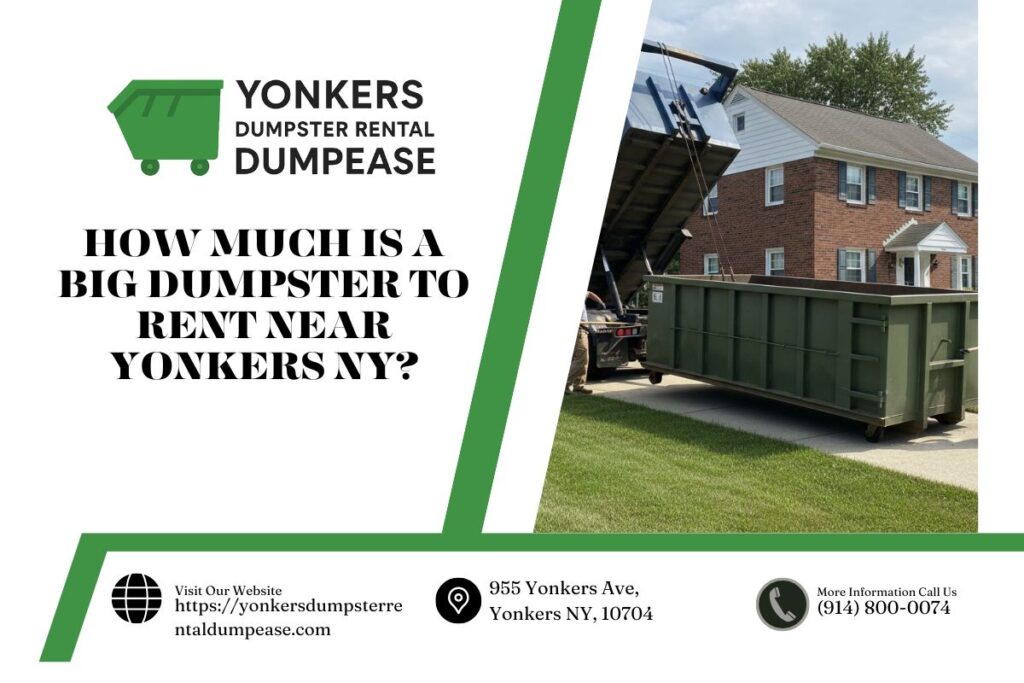
In the waste management industry, “big dumpster” refers to roll-off containers with capacities of 30 cubic yards or more, meeting specific dimensional and weight-bearing specifications set by municipal codes and DOT regulations.
You’ll find these units typically measure 22 feet in length with payload capacities exceeding 10,000 pounds. Yonkers’ infrastructure accommodates 30-yard and 40-yard configurations, engineered with reinforced steel construction and hydraulic-compatible hooklift systems.
The classification isn’t arbitrary—ANSI standards, load distribution requirements, and commercial-grade applications determine it.
When you’re managing large-scale demolitions, construction projects, or estate cleanouts, these high-capacity units deliver the volumetric efficiency and structural integrity required for handling heavy debris streams while maintaining compliance with New York State transportation codes.
See also: large dumpster rental in Yonkers NY
Three primary roll-off configurations dominate the large-capacity rental market in Yonkers: 30-yard, 40-yard, and specialized 50-yard units, each engineered to DOT specifications with distinct footprint requirements and payload thresholds.
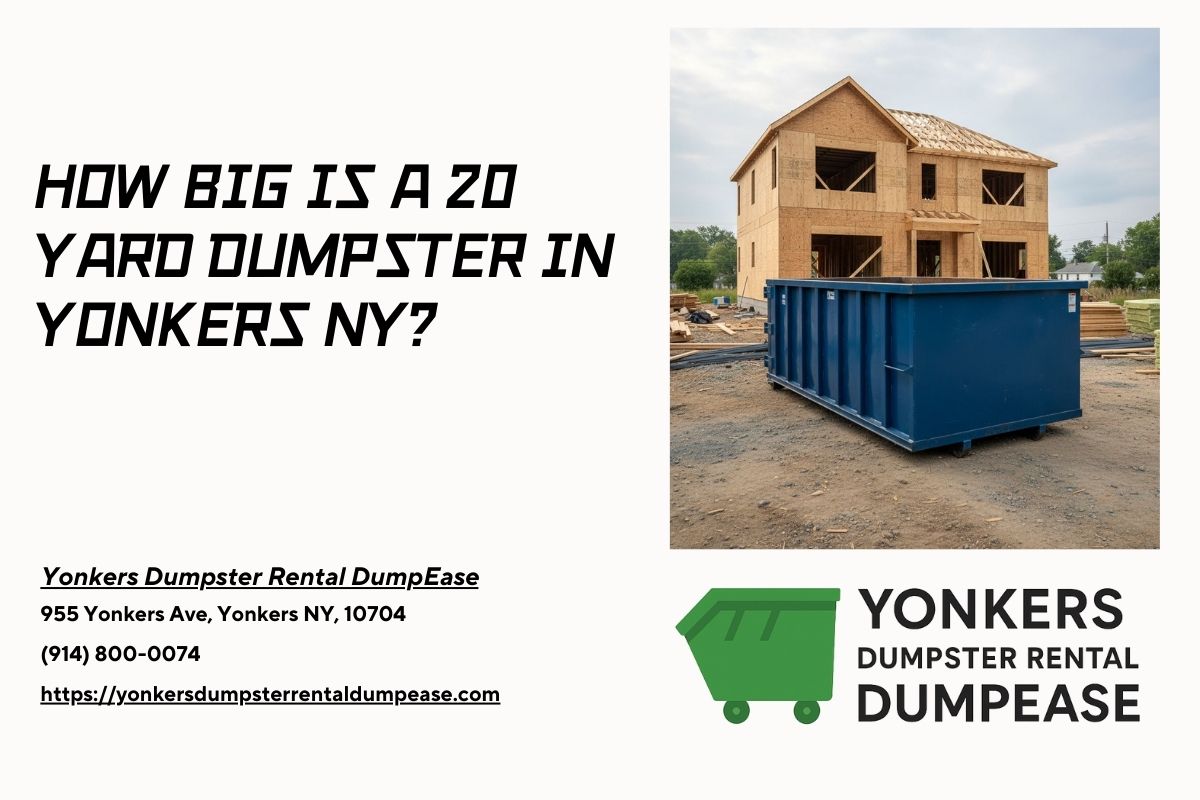
You’ll find 30-yard containers measuring approximately 22’L × 8’W × 6’H, accommodating 10-ton maximum weight limits under municipal regulations.
The 40-yard configuration extends to 22’L × 8’W × 8’H with 12-ton capacity, ideal for high-volume demolition projects requiring containerized debris management systems.
For industrial-scale operations, 50-yard units deliver 14-ton thresholds within 24’L × 8’W × 8’H dimensions.
These heavy-duty receptacles feature reinforced steel construction meeting ASTM A36 standards, integrated cable hook-lift systems, and compliance-certified sidewall bracing.
DumpEase maintains GPS-tracked fleet deployment, ensuring precision logistics coordination for your large-scale waste stream management requirements.
Understanding dimensional specifications likewise requires precise knowledge of volumetric capacity and tonnage limits that govern container selection.
You’ll find 30-yard dumpsters accommodate 170-190 cubic feet with 3.5-4 ton weight thresholds, while 40-yard units handle 230-250 cubic feet at 5-6 ton maximums. These parameters directly affect your project’s waste-stream management efficiency.
Exceeding prescribed weight limits triggers overage fees—typically $50-$75 per additional ton—making accurate load estimation critical for budget optimization.
You’re responsible for calculating debris density factors: concrete averages 4,000 lbs per cubic yard versus construction debris at 500 lbs.
DumpEase provides load-monitoring technology integration, enabling real-time weight tracking through sensor-equipped containers. This data-driven approach eliminates guesswork, prevents regulatory violations, and ensures you maximize container utilization without incurring penalties or requiring alternative haul-aways.
Multiple cost variables converge to determine your final significant dumpster rental expenditure, with pricing structures reflecting both fixed operational parameters and project-specific conditions.
Rental duration significantly affects total costs, as more extended periods require additional logistics coordination and incur opportunity costs. Geographic placement affects delivery routing efficiency and fuel allocation.
Debris classification is crucial—general construction waste commands different pricing than specialized materials that require segregated processing. Weight limits directly correlate with disposal tipping fees at certified transfer stations.
Container size selection influences both unit pricing and volumetric efficiency ratios. Permit acquisition requirements in Yonkers jurisdictions may introduce administrative overhead.
Demand fluctuations during peak construction seasons create dynamic pricing models. Overage penalties apply when exceeding predetermined weight thresholds, making accurate load estimation vital for cost optimization.
Standard dumpster configurations set predetermined weight allowances that correlate with container dimensions, creating tiered pricing based on volumetric capacity and tonnage thresholds.
When you’re evaluating big dumpster rentals, you’ll encounter standardized size-to-tonnage ratios that optimize operational efficiency:
Yonkers Dumpster Rental DumpEase provides transparent tonnage specifications across all container classes, ensuring you’ll select appropriately sized equipment that aligns with your project’s waste generation profile while minimizing overage penalties.
Most rental agreements establish baseline periods of 7-14 days, though project-specific extensions remain available through predetermined rate adjustments that maintain cost predictability throughout your waste management timeline.
You’ll find daily overage fees typically range from $5-15 per day beyond your contracted period, making planning critical for budget optimization.
Extended rental periods of 30+ days often qualify for volume-based pricing, reducing per-day costs significantly.
Real-time rental tracking through digital platforms enables proactive extension requests before deadline expiration, eliminating surprise charges.
Strategic scheduling aligned with your project milestones enhances the baseline rental value while maintaining regulatory compliance for permit-required projects.
Yonkers Dumpster Rental: DumpEase offers flexible terms tailored to construction, demolition, and large-scale cleanout operations that require adaptive waste removal.
Large dumpster rentals in the Yonkers market range from $375 to $650 for standard rental periods, with 30-yard and 40-yard containers the predominant sizes for commercial-scale projects.
You’ll find rate structures influenced by multiple variables requiring careful analysis.
Key pricing determinants include:
You’ll optimize cost efficiency by accurately specifying project scope and waste-stream composition during the initial consultation.
A 30-yard container typically costs $400-$550 in Yonkers’ commercial service zone, positioning this size class as the primary selection for medium-scale demolitions, whole-house cleanouts, and multi-room renovation projects.
You’ll find pricing variance stems from tonnage allowances (typically 3-4 tons included), rental duration parameters, and waste stream classification. Premium disposal fees apply to construction debris containing asbestos, lead paint, or other contaminated materials that require specialized processing.
Your rate structure may include fuel surcharges, permit acquisition costs for street placement, and overage charges averaging $75- $95 per excess ton.
Digital weight monitoring systems now enable real-time load tracking, eliminating disputes over tonnage calculations.
DumpEase integrates intelligent logistics algorithms to optimize route efficiency, reduce your environmental impact, and maintain competitive rate structures.
When your project requires maximum containment capacity, 40-yard dumpsters command premium rates of $450-$650 within the Yonkers metropolitan district. This reflects their classification as specialized equipment for large-scale commercial demolitions, complete property clearances, and industrial waste management operations.
You’ll encounter rate variations based on:
Yonkers Dumpster Rental DumpEase provides transparent cost structures aligned with regulatory frameworks for enterprise-level waste solutions.
Understanding these investment parameters helps you identify which applications justify deploying a large dumpster.
You’ll enhance ROI by handling complete residential teardowns, commercial building demolitions, or multi-unit construction projects that generate 12+ tons of debris.
Large-scale roof replacements exceeding 5,000 square feet and estate cleanouts involving entire property contents require this capacity.
You’re optimizing waste stream management for mixed C&D materials—concrete, lumber, drywall, and metal—that exceed the thresholds for smaller containers.
Industrial facility decommissioning requires this volume for removing equipment and structural components.
Site preparation projects, clearing land for development, benefit from consolidated debris collection.
Heavy materials such as soil, brick, and asphalt are efficiently filled into these containers.
You’ll reduce hauling frequency, minimize project interruptions, and maintain compliance with Yonkers municipal waste regulations by selecting appropriate container sizes.
Large home renovation projects generating 8-15 cubic yards of debris daily require big dumpster capacity to maintain workflow efficiency and OSHA-compliant site conditions.
You’ll need 30-40-yard containers for multi-room renovations involving structural modifications, full-house cleanouts, or estate liquidations where debris volume exceeds standard roll-off capacities.
Critical applications for large-capacity dumpsters:
Your project timeline directly correlates with appropriate dumpster sizing and rental duration optimization.
Commercial construction and demolition operations in Yonkers require 40-yard dumpsters as baseline equipment to manage demolition debris streams exceeding 300 cubic yards per phase.
You’ll need strategically positioned units to handle concrete rubble, structural steel, rebar assemblies, and non-hazardous building materials meeting EPA Region 2 disposal protocols.
Advanced logistics requires sequential container deployment synchronized with your demolition timeline—preventing site congestion while maintaining OSHA-compliant corridors.
You’re looking at rental periods of 14-30 days for multi-phase projects, with weight allowances up to 10 tons per container.
DumpEase coordinates permit acquisition through Yonkers Department of Public Works when you’re placing dumpsters in public right-of-ways.
Our fleet management system enables real-time swap-outs, ensuring continuous debris evacuation without production delays impacting your critical path schedule.
When operating within Yonkers’ municipal boundaries, you’ll navigate zoning ordinances under Title 43 that restrict dumpster placement based on residential density classifications and commercial district designations.
Your project must comply with Department of Public Works protocols, particularly regarding street obstruction permits and load-bearing assessments for placement surfaces.
Critical compliance factors include:
Before your dumpster arrives, verify that the placement area meets the dimensional specifications for your selected container size.
Standard 30-yard containers require approximately 22 feet of linear space, while 40-yard units require a minimum of 23 feet. You must verify vertical clearance of 23 feet for safe delivery and removal operations.
Surface integrity is critical—reinforced concrete or asphalt provides ideal load distribution.
Avoid placement on compromised pavement, landscaping, or underground utilities. You’re required to maintain ADA-compliant pathways and street access during occupancy.
Yonkers municipal codes mandate specific setback distances from property lines and fire hydrants.
If you’re placing your dumpster in the public right-of-way, you’ll need to obtain the appropriate permits from the Department of Public Works before delivery authorization.
Yonkers Municipal Code Chapter 270 establishes mandatory permitting protocols for all temporary waste containers located in the public right-of-way.
You’ll need to secure proper authorization before placing your big dumpster on streets, sidewalks, or municipal property. DumpEase streamlines this compliance process.
Key regulatory requirements include:
Non-compliance triggers penalty assessments ranging from $250-$1,000 per violation.
We’ll coordinate with Yonkers Building Department to guarantee your project maintains full regulatory compliance while maximizing operational efficiency.
You can upgrade to a larger dumpster mid-rental by contacting us directly. We’ll coordinate the container exchange, adjusting your service agreement and billing accordingly. This ensures compliance with load capacity regulations and efficiently meets your project’s evolving waste management requirements.
Yes, you’ll find same-day and next-day delivery options available for big dumpsters, subject to fleet availability and dispatch scheduling. Contact our logistics team early to secure expedited deployment that meets your project’s time-sensitive requirements.
You’ll find that we accept all major credit and debit cards, as well as ACH transfers, for streamlined transactions. Our digital payment infrastructure guarantees secure, compliant processing while accommodating your preferred method—whether corporate accounts or individual payments require specialized handling.
Yes, you can’t dispose of hazardous materials, including chemicals, asbestos, paint, batteries, tires, and electronics in big dumpsters. You’ll need specialized disposal services for these regulated items to guarantee environmental compliance and safety.
You’ll receive volume-based pricing adjustments and loyalty incentives through our tiered discount structure. We’ve engineered competitive rate reductions for multi-unit deployments and recurring service agreements, ensuring you maximize cost efficiency while maintaining regulatory compliance.