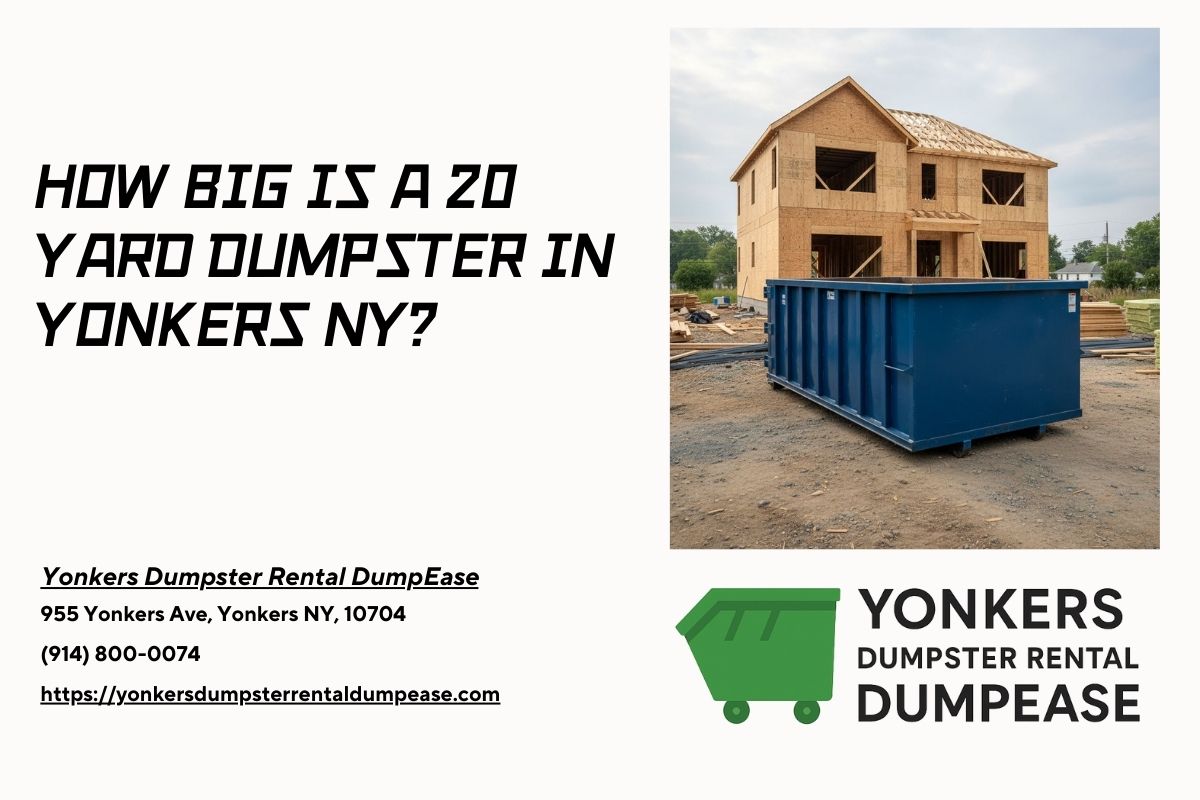

A 20-yard dumpster in Yonkers has a total capacity of 540 cubic feet, calculated from standard dimensions of 22 feet long, 7.5 feet wide, and 4.5 feet high. However, your usable volume is typically 480-500 cubic feet due to fill-line restrictions and municipal regulations. Weight limits of 2-3 tons often become the limiting factor before you reach full volumetric capacity, especially with dense materials such as concrete or roofing debris. Understanding how material density affects both measurements will help you optimize your rental investment.
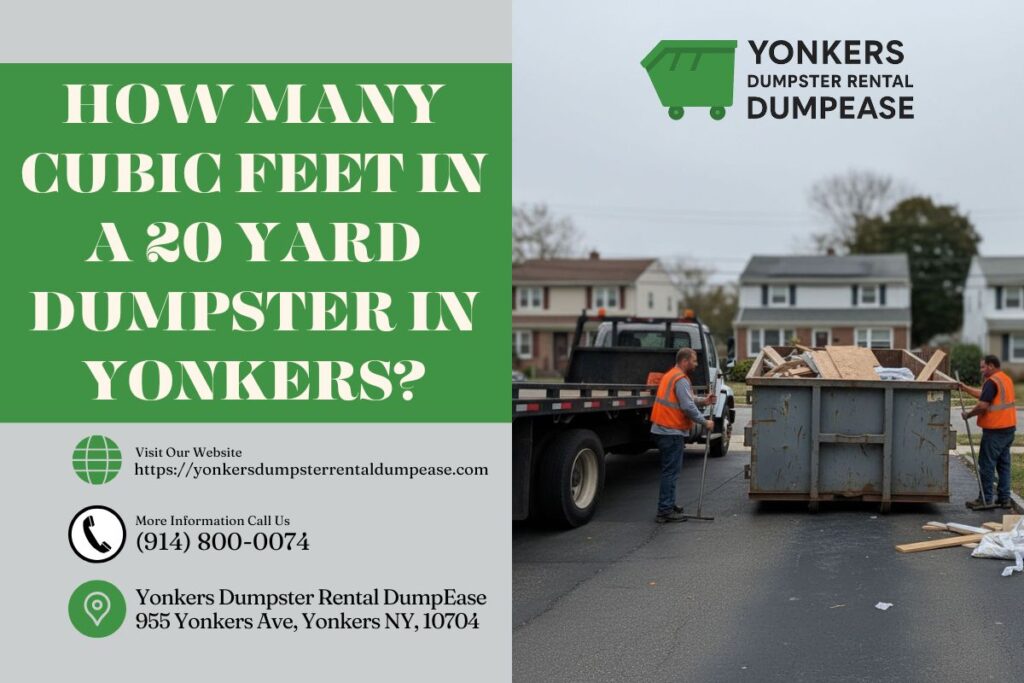
When you’re calculating waste disposal capacity, understanding the relationship between cubic yards and cubic feet becomes essential for accurate project planning. A 20-yard dumpster contains exactly 540 cubic feet—derived from the standard conversion where one cubic yard equals 27 cubic feet (3′ × 3′ × 3′).
You’ll need this measurement to optimize your waste management strategy and prevent cost overruns from underestimating capacity.
These specifications aren’t arbitrary. They’re industry-standard metrics that align with EPA waste-stream calculations and municipal disposal regulations in Yonkers.
When you’re evaluating project debris—whether construction materials, demolition waste, or bulk cleanouts—converting between cubic units ensures compliance with weight and volumetric limits.
DumpEase uses these precise calculations to match your project’s needs with the appropriate container specifications, eliminating guesswork from your waste management process.
See also: Yonkers 20 yard dumpsters for rent
Cubic feet quantify the three-dimensional space your waste occupies within a dumpster’s steel walls and serve as the primary metric for material volume in commercial waste management operations.
You’ll calculate cubic feet by multiplying length × width × height in feet to establish precise load capacity for regulatory compliance and efficient space utilization. This measurement determines the ideal container selection for your Yonkers project, preventing costly overages and ensuring compliance with municipal weight restrictions.
When evaluating debris volume, cubic feet are a standardized unit that directly translates to disposal costs and hauling efficiency. Understanding this metric enables you to implement streamlined waste management protocols, maximizing payload density while maintaining Department of Sanitation compliance standards.
DumpEase utilizes these calculations to deliver data-driven container recommendations for your operations.
Dumpster volume calculation follows a standardized geometric formula: length (feet) × width (feet) × height (feet) = total cubic feet. This mathematical approach guarantees precise capacity measurements across the waste management industry.
Standard 20-Yard Dumpster Specifications:
When you’re planning your Yonkers renovation or construction project, understanding these specifications helps you estimate waste accurately.
The formula applies universally, though the usable volume may vary slightly due to container design features such as sloped walls or reinforcement structures.
DumpEase provides precise measurements guaranteeing compliance with municipal regulations.
A standard 20-yard dumpster has a volume of precisely 540 cubic feet, though you’ll notice this differs from the 742.5 cubic feet we calculated from external dimensions.
This discrepancy exists because manufacturers measure usable interior space, accounting for wall thickness, structural reinforcements, and the angled design that prevents overfilling.
Industry standards established by waste management associations define volumetric capacity based on fill line markers, not total container dimensions.
When planning your project in Yonkers, you’ll need to use this 540-cubic-foot capacity for accurate load calculations.
This standardized measurement guarantees regulatory compliance across disposal facilities and prevents overloading violations.
At DumpEase, we emphasize these precise specifications because understanding actual capacity optimizes your rental selection, reduces costs, and maintains safety protocols throughout your waste management process.
Your ideal approach integrates mathematical precision with real-world loading constraints to improve cost efficiency.
While volumetric calculations provide the theoretical 540 cubic feet capacity, you’ll find that standard 20-yard dumpster dimensions of 22 feet long × 7.5 feet wide × 4.5 feet high create specific spatial constraints that affect your project planning.
The interior space configuration directly impacts loading efficiency—you’re working with a rectangular container that accommodates materials differently than raw cubic footage suggests. Understanding these dimensional parameters enables optimized waste placement strategies, particularly for bulky items or construction debris.
At Yonkers Dumpster Rental DumpEase, we’ve documented that strategic loading based on actual interior dimensions can improve capacity utilization by 15-20%. The 7.5-foot width particularly influences how you’ll position larger materials, while the 4.5-foot height determines vertical stacking capabilities.
These specifications matter when calculating project logistics and ensuring regulatory compliance with Yonkers municipal waste ordinances.
Typical residential cleanouts generate 180-220 cubic feet of debris, representing roughly 33-41% of a 20-yard dumpster’s 540-cubic-foot capacity. This baseline metric illustrates why you can efficiently manage medium-scale projects within standard volumetric parameters.
Optimal Applications for 20-Yard Container Deployment:
Yonkers Dumpster Rental DumpEase optimizes your volumetric calculations for precise project planning.
Understanding volumetric displacement becomes critical when you’re calculating how common debris materials consume your 20-yard dumpster’s 540 cubic feet—drywall sheets occupy 1.5 cubic feet per 4×8 panel, dimensional lumber averages 0.67 cubic feet per 2x4x8 stud, and standard concrete fragments fill approximately 15 cubic feet per ton (though weight restrictions typically cap concrete loads at 1-2 tons regardless of available volume).
Carpet padding compresses to roughly 0.5 cubic feet per square yard, while roofing shingles require 3.5 cubic feet per bundle.
Yonkers Dumpster Rental: DumpEase recommends breaking down bulky items to increase load capacity—disassembled furniture, flattened cardboard, and segmented drywall increase load efficiency by 35-40%.
You’ll improve your rental investment by strategically loading dense materials first, distributing weight evenly throughout the container.
Commercial construction projects generate approximately 4.5 pounds of waste per square foot of building space, translating to substantial volume requirements that’ll quickly consume your 20-yard dumpster’s 540 cubic feet capacity.
High-Volume Construction Materials:
You’ll need precise volumetric calculations when disposing of mixed construction streams to guarantee regulatory compliance and cost-effectiveness in Yonkers.
Although your 20-yard dumpster provides 540 cubic feet of volumetric capacity, you’re also constrained by weight limits typically ranging from 2-3 tons (4,000-6,000 pounds) under Yonkers municipal regulations.
This dual-constraint system means you’ll rarely optimize both dimensions concurrently. Dense materials like concrete or soil achieve weight limits at approximately 30-40% volumetric capacity, while lightweight debris such as cardboard or insulation may fill the container before approaching weight thresholds.
Understanding material density becomes critical for enhancement—concrete averages 150 pounds per cubic foot, whereas construction debris typically ranges 40-60 pounds per cubic foot.
Calculate your specific waste stream’s density coefficient to determine whether volume or weight is the limiting factor, enabling precise dumpster selection and preventing costly overage fees from Yonkers Dumpster Rental DumpEase.
When planning your dumpster rental in Yonkers, you’ll need to determine whether volumetric or weight limits govern your project’s disposal requirements. A 20-yard dumpster has a capacity of 540 cubic feet, but exceeding the weight limit triggers overage fees regardless of volume.
Critical decision factors:
Calculate material density coefficients before selecting your dumpster size.
DumpEase provides load optimization consultations to improve efficiency and minimize costs.
Specific construction and demolition materials exponentially accelerate weight accumulation in your 20-yard dumpster—often reaching the 3-4 ton limit while occupying just 15-20% of the available 540 cubic feet. Understanding these density differentials enhances your rental strategy and prevents overage fees.
| Material Category | Weight per Cubic Yard | Volume Efficiency |
|---|---|---|
| Concrete/Asphalt | 3,000-4,000 lbs | Critical ⚠ |
| Soil/Clay/Sand | 2,200-3,000 lbs | High Risk 🔴 |
| Roofing Shingles | 2,100-3,400 lbs | Moderate ⚡ |
You’ll need specialized heavy debris containers for concrete demolition projects. Alternatively, mixing lightweight materials (drywall, wood framing) with dense substances increases both volumetric and weight capacities. Yonkers Dumpster Rental: DumpEase provides load-optimization consultations to prevent costly weight violations while maintaining regulatory compliance.
Yonkers municipal code requires permits for dumpster placement on public streets, with application processing times averaging 3-5 business days through the Department of Public Works.
You’ll need to account for these regulatory timelines when scheduling your 540-cubic-foot container delivery.
Critical Yonkers-Specific Requirements:
DumpEase navigates these compliance requirements while optimizing your 20-yard dumpster placement for maximum efficiency within Yonkers’ regulatory framework.
Beyond permit compliance, your 20-yard dumpster requires 60 feet of linear street space and 22 feet of vertical clearance for safe delivery and pickup.
These specifications define our hydraulic roll-off truck’s operational parameters and prevent overhead obstructions, such as power lines or tree branches, from interfering with container deployment.
Ground-level positioning requires a flat, stable surface capable of supporting 6-8 tons under load.
Yonkers Dumpster Rental DumpEase recommends placing protective boards beneath the container to prevent asphalt scarring or concrete damage.
You’ll need 14 feet of width to accommodate the dumpster’s 8-foot body plus door clearance.
Site accessibility requires a minimum 10-foot approach width for truck navigation.
Document your placement area’s dimensions and overhead restrictions before scheduling delivery to optimize operational efficiency and eliminate costly repositioning requirements.
While your 20-yard dumpster’s 540-cubic-foot capacity accommodates substantial debris volumes, Westchester County’s disposal regulations require strict material segregation.
Critical Compliance Metrics:
Yonkers Dumpster Rental: DumpEase monitors these parameters with GPS-enabled load verification systems, ensuring your 540-cubic-foot volume is handled compliantly and cost-effectively across Westchester County’s regulated waste infrastructure.
You’ll pay between $350 and $550 for a 20-yard dumpster rental in Yonkers, depending on your project duration, debris type, and disposal requirements. We’ll provide transparent pricing with no hidden fees, ensuring you’re maximizing your waste management investment efficiently.
You’ll typically keep a 20-yard dumpster for 7-14 days with standard rentals. We offer flexible extensions based on your project timeline and compliance requirements. Extended periods incur additional fees calculated per day beyond the duration covered by your initial rental agreement.
You’ll need a permit if placing the dumpster on public property like streets or sidewalks in Yonkers. Contact the City’s Department of Public Works at (914) 377-6400 to verify specific requirements and obtain necessary permits.
You can’t dispose of hazardous materials, electronics, tires, batteries, propane tanks, medical waste, or flammable liquids in Yonkers dumpsters. We’ll provide compliant disposal options and guarantee your project complies with all applicable municipal regulations.
DumpEase typically delivers your 20-yard dumpster within 24-48 hours of order confirmation in Yonkers. You’ll receive real-time tracking updates and precise delivery windows, ensuring efficient project coordination. Same-day delivery’s available for urgent needs when you request expedited service.